
It's eleven at night in a Hanoi apartment, three weeks after a laser session or partway through a course of tretinoin. The skin is thin, faintly pink, still catching on a towel. Tomorrow means going outside, which means sunscreen.
The search that follows, in Vietnamese skincare forums, doesn't read like "best sunscreen 2026." It reads like a specific, almost clinical question: should treatment skin use physical or chemical sunscreen.
That question sits inside Match Skin Type, one of ten Decision Steps in Consensys AI's Sun Protection category LLM for Vietnam. Consensys AI calls this framework its Demand Steps: the weighted, named moments that structure every category, each built from millions of real reviews, forum threads, social conversation, and search queries — not from what a chatbot happens to say when asked for a recommendation.
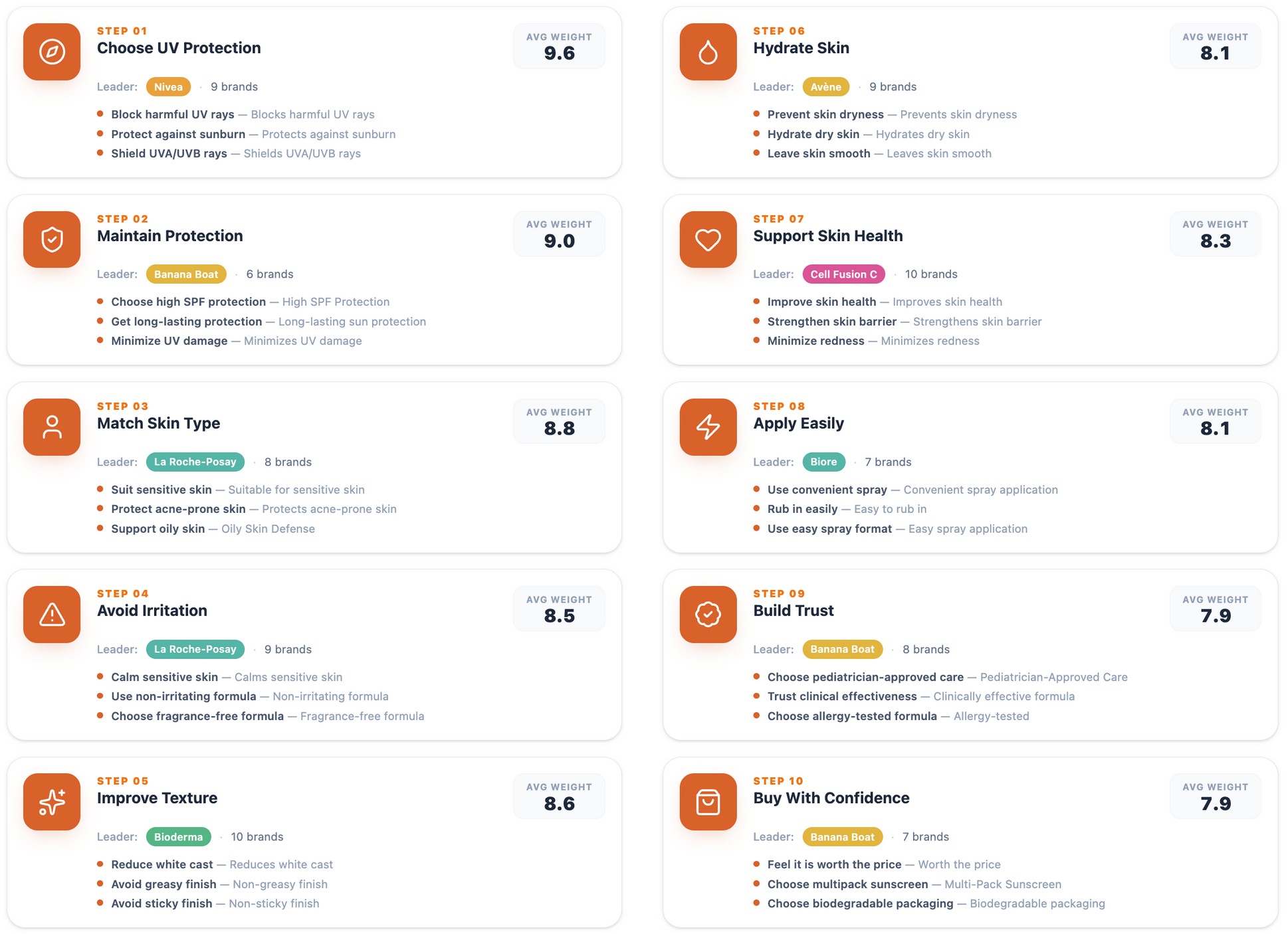
Match Skin Type carries an average weight of 8.8 and is led by La Roche-Posay across 8 competing brands. But leading this step doesn't mean the underlying need is being met.
A skin category Western marketing barely names
What that Demand Step surfaces is a skin category Vietnamese consumers call treatment skin: skin currently undergoing an active-ingredient routine (retinoids, acids), or recovering from a cosmetic procedure like a peel or laser session. It's discussed as its own category, with its own dedicated product logic — not as a subset of general "sensitive skin" marketing.
What the community actually says
The language doesn't hedge. Across reviews, forums, and search queries collected for this Demand Step, the same handful of concerns surface again and again:
- "Physical sunscreen gentle, no irritation for sensitive or treatment-recovering skin."
- "Suitable for skin after peeling or on strong treatment routines."
- "A gentle ingredient list free of alcohol, fragrance, and paraben is the top priority."
- "Dermatologist recommended for skin undergoing acne or melasma treatment."
- "Should treatment skin use physical or chemical sunscreen?"
That last line is the one worth sitting with. It isn't rhetorical. Forum threads treat "physical or chemical" as a genuinely open, frequently debated question, and it consistently pulls in a second live conversation: Vietnam's tone-up and white-cast debate.
'Physical or chemical?' — treatment-skin sunscreen question
Buyers on retinoids, acids, or post-procedure recovery ask which UV filter is safe — a live, medically answerable question most product content ignores.
Sensitive and treatment-skin buyers specifically avoid tinted, brightening formulas, treating any whitening additive as one more variable on skin that already has none to spare. On the surface these look like two different topics: filter chemistry and cosmetic tint. But they come from the same instinct. Fewer ingredients, fewer unknowns, on skin with no margin for error.
The dermatology behind the question
Ask a dermatologist why "physical or chemical" matters so much here, and the answer isn't aesthetic. It's mechanical.
Chemical UV filters work by absorbing radiation and converting it into heat, which the skin then dissipates. On intact, healthy skin, that heat is negligible. On a barrier thinned by retinoids, acids, or a recent peel or laser session, that same heat release can aggravate inflammation and worsen the exact post-inflammatory hyperpigmentation the treatment was meant to fix in the first place.
It's precisely why post-procedure aftercare protocols consistently specify mineral filters — zinc oxide and titanium dioxide — which sit on the surface and reflect UV rather than absorbing it. When a Vietnamese treatment-skin buyer asks "physical or chemical," they are, without necessarily knowing the mechanism, asking the medically correct question.
The tone-up tension has an equally concrete explanation once you look at the formulation. Tone-up sunscreens brighten by layering light-reflecting mineral pigment on top of standard UV filters — a cosmetic addition, not a protective one. For a buyer whose entire goal is minimizing variables on compromised skin, that extra pigment is a legitimate reason to walk away from an otherwise suitable formula, not a matter of taste.
The humidity constraint no imported formula solves
Vietnam's climate adds a third, harder constraint that the reviews and forums keep circling back to. With humidity regularly above 80%, heavier "gentle" creams that perform well in temperate markets tend to sit on the skin and congest pores rather than absorb — the exact tension Vietnamese skincare culture has already named and solved for general use. Locally, the standard is described as "suơng suơng": light, barely-there, almost nothing on the skin.
Treatment-skin sunscreen specifically hasn't caught up to that standard, which leaves this buyer choosing between a formula that's gentle but heavy, or light but not built with their condition in mind. It's a real, unresolved formulation gap, not simply a matter of brands failing to communicate an existing solution.
Postcare, dermatology-adjacent sun protection positioning
Closest brand in Vietnam to naming treatment-skin sunscreen directly, without yet using the words.
View sourceWhat treatment skin actually needs to hear
Put those three threads together — filter chemistry, tint refusal, humidity — and what this buyer needs from product content is specific, not vague. Which filter is inside, whether the formula adds tint, and whether it's made for a named condition (post-procedure recovery, active acne, melasma) rather than a generic skin type.
Look at what's actually on shelf for this need, and most of it answers none of the three. It defaults to generic "sensitive fit" and "dermatologist cue" language that could describe almost any sunscreen in the category, reaching for reassuring adjectives — gentle, soothing, dermatologist-tested — exactly where this buyer wants a checkable fact.
The whitening default is the clearest example, and it's a punchline the market didn't need to manufacture. Sunplay Skin Aqua Clear White, one of the most visible products in the category, leads with a whitening or brightening effect as its headline benefit, since that's the dominant expectation in general Vietnamese sun care. For a treatment-skin buyer, that same headline is a reason to put the product back on the shelf. The gap isn't a bad formula. It's a mismatch between what the product foregrounds and what this buyer is actually screening for.
On the other side of that gap, Cell Fusion C already builds part of its identity around post-procedure, dermatology-adjacent positioning — closer than most of the category to naming this need directly, even without using the words "treatment skin" itself. That's the model worth extending: not softer language, but more specific, more clinical, more condition-named communication.
The one thing to remember
Treatment-skin buyers aren't asking for a gentler tone. They're asking three specific questions: which filter, any tint, suited for which condition. Most product content answers with reassurance instead of facts.
Closing that gap is a communication problem, not a formulation one. The underlying need — mineral filters, no tint, a named condition — is already understood by the people who have it. It just hasn't been matched by product content that speaks in the same specific terms.
How to Win: Sensitive Skin
Five moves, ranked by how directly they close the gap between the real question this buyer is asking and what today's product content currently answers:
Whitening headline as category default
Leads with brightening/whitening effect — the exact reason treatment-skin buyers screen it out.
View source- FOCUS 01 · Say "mineral filters only" explicitly. Don't just say gentle. Name zinc oxide or titanium dioxide directly. That's the actual clinical reason this buyer should choose the product.
- COMMUNICATE 02 · Separate "tint-free" from "brightening". Treatment-skin buyers are minimizing variables, not seeking a cosmetic finish. Don't blend the two claims in one SKU.
- ACTIVATE 03 · Name the specific condition and format. "Suited for post-peel/laser recovery" or "suited for active acne treatment" outperforms a generic dermatologist-tested badge for this buyer.
- DEFEND 04 · Cell Fusion C: own "postcare" fully. Already the closest brand in-market to this positioning. Extending explicitly into mineral-only, treatment-skin language locks in the space before a competitor names it first.
- GROW 05 · Challengers: answer the real question. "Physical or chemical sunscreen for treatment skin" is a live, specific, medically answerable question that almost nothing on shelf currently addresses directly.
Sources & evidence
Verified brand sources referenced in this report:
- La Roche-Posay Vietnam — https://www.larocheposay.vn/
- Bioderma Vietnam — https://www.bioderma.com.vn/
- Cell Fusion C — https://www.cellfusionc.com/
- COSRX — https://www.cosrx.com/
- Sunplay — Rohto Vietnam — https://rohto.com.vn/san-pham/san-pham-noi-dia-viet-nam/cham-soc-da/sunplay/